With miniscript on taproot in core, and support coming soon in hardware signers, we will start seeing wallets exploring the new possibilities.
One thing that will probably be useful for certain use cases and that doesn’t have clear specs to day is: how to create spending policies with unspendable keys?
That’s particularly important in taproot, as one might desire to create a wallet that can only be spent using the script paths; for example, because all the spending conditions require a timelock, or not expressible as a musig/FROST keypath.
It’s easy to create a specific unspendable keys or xpubs; for example: xpub661MyMwAqRbcEYS8w7XLSVeEsBXy79zSzH1J8vCdxAZningWLdN3zgtU6QgnecKFpJFPpdzxKrwoaZoV44qAJewsc4kX9vGaCaBExuvJH57, constructed by taking the NUMS point suggested in BIP-0341 and attaching a chaincode made of 32 0 bytes.
However, there are desirable properties that it’s not trivial to achieve:
unspendable keys should be indistinguishable from a random key for an external observer;
in a descriptor with the range operator (like the wallet policies compatible with most known wallet account formats), each change/address_index combination must generate a different unspendable pubkey , and they should not be relatable to each other (in order to avoid fingerprinting);
the fact that a certain key is unspendable should be easy to detect with full knowledge of the descriptor;
additional entropy needed for this key should be avoided or minimized.
Properties (3) and (4) help providing a better user experience when using such spending policies with a hardware signing devices, where minimizing what’s shown on-screen is important. For security reasons, any entropy that is part of the descriptor/wallet policy must be inspected by the user when they register the policy on the device, and compared with their backup. A worse user experience does in fact result in worse security in practice, especially with less experienced users - as they tend to skip the paranoid security steps.
A key observation is that the unspendable pubkey cannot depend on information that is not in the descriptor itself (including private or public key material generated from the seed of the participants): that would make watch-only wallets impossible.
It’s unclear to me if there is any interesting use case for unspendable keys outside of the taproot keypath, but some of the solutions below might work for that as well.
I’ve been brainstorming some of the possible approaches, which I list below.
Solutions
(s0) Use a fixed unspendable xpub
Just use xpub661MyMwAqRbcEYS8w7XLSVeEsBXy79zSzH1J8vCdxAZningWLdN3zgtU6QgnecKFpJFPpdzxKrwoaZoV44qAJewsc4kX9vGaCaBExuvJH57 above.
This is easy, but of course it only satisfies (3) and (4) and is giving up on (2) and (3)
(s1) Use a root xpub with unspendable pubkey and random chaincode
Instead of using the above xpub, on could generate a random unspendable xpub by using a random chaincode instead of a fixed constant.
As long as the xpub is followed by a /* in the descriptor (as it’s common in today’s wallets that use xpub/<0;1>/*), this satisfies (1) and (2). It also satisfies (3), since the compressed public key of the root descriptor is fixed.
It is not ideal for (4), as the additional entropy must be part of the backup, and be part of the information inspected on the hardware signer screen during registration of the wallet policy.
(s2) BIP-0341 approach: H + r*G
BIP-0341 suggests using a pubkey generated as H + r*G, where H = lift_x(0x50929b74c1a04954b78b4b6035e97a5e078a5a0f28ec96d547bfee9ace803ac0) is the NUMS point mentioned above, and r is a random number in 0..n-1 where n is the curve order.
One can imagine a KEY expression unspend(r) (with a fixed chaincode so it can be used in further derivations).
Of course, since r is chosen from a rather large set, this has the same properties as the previous approach: (1), (2) and (3), not optimal for (4).
(s3) Entropy from the taptree (keypath only)
Based on an idea from Antoine Poinsot: define a new fragment, say tree(TREE) (taptree only, without keypath), where the keypath is computed as a NUMS point with the previous approach, where r is the hash of the taptree.
This is ideal w.r.t goals (2), (3) and (4). Fingerprinting is not ideal, as the fact that there is no keypath is revealed at spending time.
One slight caveat compared to the approaches based on generating a provably unspendable xpub is that descriptors using the new fragment are not interoperable with wallets that didn’t implement the new fragment type.
(s4) Recycle the entropy of the descriptor
As the “entropy” of the unspendable key must be public to anyone that knows the descriptor, one approach could be to use the entropy in the descriptor itself to generate the unspendable pubkey.
A typical descriptor used in wallets today contains a number of xpubs, followed by /<M;N>/* (that is, usually /0/* for receive addresses, or /1/* for change addresses.
One could generate an unspendable xpub as follows:
generate the pubkey as H + r*G above, where r is the SHA256 of the concatenation of all the compressed pubkeys in the descriptor that have a /<M;N>/*, in some canonical order (e.g. left-to-right in the descriptor)
choose a fixed chaincode, like all zeros.
EDIT: perhaps simpler:
use the fixed unspendable pubkey
use r for the chaincode.
The KEY expression could be modified to allow a special marker that represents this special unspendable xpub, say _.
For example, a taproot descriptor for a wallet with a single leaf that is an old-style multisig would be:
tr(_/<0;1>/*,multi_a(xpub1/<0;1>/*,xpub2/<0;1>/*)
(which can be more succinctly represented as tr(_/**,multi_a(@0/**,@1/**)) as a descriptor template for wallet policies)
The _ could easily be converted to the actual pubkey if the descriptor needs to be imported in software that doesn’t understand _.
This approach would generate the same unspendable xpub for both a descriptor, but also the corresponding wallet policy (when a compatible wallet policy exists).
All the properties (1-4) above are satisfied.
TBD:
Should more than one _ be allowed in the descriptor? Should the same xpub generated every time? Or should it only be allowed in the taproot keypath?
Probably _ not followed by /<0;1>/* should be disallowed.
Is there any simpler way to get all 4 properties?
Conclusions
Among the approaches that do not change any standard, (s1) is probably the most practical today: it’s straightforward for hardware signers to detect such xpubs. The UX is a bit worse, but not by a lot – as there is anyway plenty of other information that the user has to inspect anyway.
Among the forward-looking approaches that do require a syntax addition to descriptors, (s4) seems ideal in the spirit, but it feels a bit dirty and unsatisfactory when applied to descriptors. The scheme is much cleaner in the context of wallet policies, since they already separate the descriptor template from the xpubs, and are designed as a much more restricted language.
Implementing this only for wallet policies might also be an option if they become a more widely adopted standard to backup descriptor-based wallets, but that is probably premature today.
I look forward to your ideas and any cleaner approaches that I might have missed.
At TabConf 2022 we had a little meeting where we discussed avenues for improvement to miniscript/descriptors, which included an idea for unspendable keys: descriptor_changes.md · GitHub
I just wanted to post it here as background; I’ll comment on your ideas here when I’ve had a chance to digest it.
One observation is that unspend(HEXCHAINCODE) from your gist is actually compatible with the approach (s4) if the HEXCHAINCODE is deterministically computed according to the specs above, or any similar ones.
So the TL:DR is: you do need some good entropy for the unspendable key, but you don’t need new entropy.
Why is (1) a desirable property? I can think of one example (BIP352 - Silent payments) where we would want to standardize the use of H in protocols that require a provably unspendable keypath. Curious if you have any counter-examples where a standard public NUMS is not desirable.
Especially in this setting, revealing a recognizably unspendable internal key at spending time (remember, internal key is revealed in script path spends) would instantly reveal to the world that this was a script-only taproot output.
This part I understand; I’m asking for an example of why revealing this to the world is bad. It certainly feels safer to not reveal it, but when discussing this with @RubenSomsen in the context of BIP352 where it would be beneficial to reveal to the world that this was a script-only spend, I struggled to come up with examples of why it would be bad to reveal this.
It is a form of fingerprinting. You can always reveal this information yourself if you want/need it, but it’s great if the standards don’t force you to do so.
More of a fingerprint than the script itself? My thinking here is that in these protocols that require a provably unspendable keypath, the scripts themselves are likely sufficiently complex to be a fingerprint and must be revealed with every spend, anyways.
It seems satisfying all those properties would prevent the possibility of creating addresses using partial descriptors. Since you necessarily need additional information which isn’t onchain.
I can certainly imagine specific use cases where this will be the case, and revealing that the key path was unspendable isn’t an additional privacy loss over revealing the script itself.
But I also don’t think this is universally true. Maybe the script is just covering some combination of participants unable to MuSig sign a key path. Maybe there are very distinguishable scripts in the script tree, but there are others which aren’t. And I hope you’d agree that we shouldn’t adopt a standard that forces participants to reveal their key path was unspendable.
FWIW, even with the P = H+rG approach mentioned in BIP341 (with secret r) you can prove to contract participants that the key is unspendable, even without revealing r (by producing a BIP340 signature for key P-H, which has private key r).
Maybe we want different properties for descriptors and wallet policies. We could both have the entropy be explicitly described in a descriptor (unspend()), and omitted for wallet policies since this standard would mandate the content of unspend() be deterministically derivable from the rest of the descriptor.
So properties (1), (2), (3) for output descriptors. And property (4) in addition for wallet policies.
⚠ post #14 missing (not fetched, or removed/moderated on the source site)
The only issue is that people today backup descriptors and not wallet policies, so the discrepancy is a UX problem at registration time.
I think people should backup wallet policies to represent accounts in software wallets, except for the exotic use cases where wallet policies don’t work.
Certainly agree on this point, but also don’t want to leave wallet users with the impression that this is chosen as a standard because revealing that only the script path was usable is always bad for privacy.
Good to know! For BIP352, the scenario I had in mind for revealing that the keypath was unusable is a coinjoin, where Alice wants to coinjoin her provably unspendable keypath UTXO and Bob wants to make a payment to a SP address. It sounds like in this scenario Alice could provide a signature for P - H to a coordinator, instead of the coordinator requiring that her script path spend show that H was the internal key.
EDIT: nevermind, this doesn’t work. It’s about the receiver knowing that the taproot spend was a script-only spend, and AFAICT there is no way to do this in a non-interactive way outside of making it public that only the script path was usable.
Approach s2, corresponding to the descriptor changes document linked by @sipa above, seems straightforward to implement and very simple to explain. Yes, it comes at the expense of having to include some extra information in the descriptor. This seems like a worthwhile tradeoff given its simplicity.
sipa’s linked approach is similar but not identical to s2, as in his version the argument of unspend() alters the chaincode, while in the version described in my notes above I was instead generating a different pubkey.
They are identical in terms of security properties, but I think sipa’s approach is better as it’s more straightforward to verify that one such xpub is unspendable (just look at the pubkey), while in the approach in s2 one has to explicitly redo the computation to verify how the xpub is generated.
Anyway, my current thinking is that sipa’s approach is probably the cleanest for descriptors, while wallet policies (now in the process of being finalized as BIP-0388) could add a deterministic way of computing the HEXCHAINCODE from the remaining keys, as suggested above by @AntoineP.
I’m now implementing Taproot support in Liana. Ideally i’d like to derive unspendable internal keys in a way which would be forward compatible with an eventual standard used in wallet policies. This way, once support is implemented in signing devices, our users won’t have to “verify” a meaningless internal key on their device’s screen. A friendlier “no keypath spend” UX could be presented.
It seems the less ugly way of getting all 4 properties is what Salvatore suggests in s4 (in the simpler version). From a wallet policy, the unspendable internal key is an xpub/<0;1>/* such as:
The xpub’s key is the NUMS suggested in BIP341: H = lift_x(0x50929b74c1a04954b78b4b6035e97a5e078a5a0f28ec96d547bfee9ace803ac0).
The xpub’s chaincode is the sha256 of the concatenation of the key part (as a compressed pubkey) of all the xpubs in the wallet policy. (In the wallet policy standard all key expressions must be xpubs with derivation path of the form /<m;n>/*.) “Left to right” order as they appear in the string representation, which is just a depth-first search.
Of course, this can also be expressed in descriptors using unspend(computed chaincode)/<0;1>/* as the internal key.
An issue with using left-to-write is that since wallet policies have a separate list of xpubs (that are explicitly referenced by @index in the descriptor template), the natural order of the keys would be the one in the list, which is not guaranteed to match the left-to-right order in the descriptor template.
Here the left-to-right order doesn’t match with the natural order pubkeyA||pubkeyB.
If the _ (or whichever other expression) to represent the deterministic NUMS key is only defined for wallet policies, I’d favor the wallet_policy-native approach.
Your approach requires to have the wallet policy at hand, whereas mine can be used on any wallet-policy-compatible descriptor. I think it’s a nice property to have.
The _ placeholder would be a wallet policy feature, so expecting to have the wallet policy seems a natural assumption, and I don’t think the standard should be optimized for “not having it”.
Other orders push code complexity to the hardware signer, that will now have to add more code to parse the “descriptor template” just to find the right order of keys.
Finally, a wallet policy might have the same @i multiple times (especially on taproot); in your version you’d either be concatenating the corresponding pubkey multiple times, or would need a stateful parser to skip the ones that have been seen already.
An issue with using left-to-right is that it makes sortedmulti_a depend on the order of keys added now.
A sortedmulti_a(k,KEY_1,KEY_2,...,KEY_N) descriptor is identical to sortedmulti_a(k,KEY_N,KEY_N-1,...,KEY_1), but this will create a different chaincode with this approach.
I agree with @andrewtoth that it would be most beneficial if the chain code would be derived from the XPUBs independently of their order. It would alleviate the issue of whether the wallet policy order or the descriptor order should be used, as well as the mentioned surprising behavior with sortedmulti_a.
I see three possible approaches to achieve this:
Sort the XPUBs, then hash the sorted and concatenated list.
Hash each XPUB, then XOR the results. (Problem: repeated XPUBs would cancel out. I suppose that may happen in more complex descriptors/policies.)
Hash each XPUB, then add the results mod 2^256. (Repeated XPUBs don’t cancel out.)
Instead of XPUBs it may be simpler to work with only a part of the XPUB, i.e. the compressed public key, as @AntoineP did, or with the chain code. In fact, I think the chain code could be used directly in options 2 or 3 without hashing it, i.e. just a XOR-sum of the chain codes or a mod 2^256 sum of the chain codes. That would make for a very simple implementation. A potential risk of not hashing is that a malicious participant could craft the chain code in their XPUB so that it cancels out with the other participants to force the result to a desired value. However, such a malicious participant could just as well publish the dummy XPUB to achieve the same goal, so I don’t see a problem with a simple sum of the chain codes.
To ensure smooth interoperability amongst different wallets, it would be very helpful if we could agree on standardizing unspend() with deterministic HEXCHAINCODE.
I think publishing the dummy XPUB out of band to interested parties is not exactly the same goal as making the dummy XPUB obvious to any observer of the transaction.
If we would like an unspendable internal xpub to be standardized between descriptors and wallet policies, then we must remove duplicates. I think sorting and removing duplicates of all xpubs, then concatenating and SHA256 hashing the result would be the simplest to implement.
We would also have to restrict all xpubs to xpub/<0;1>/* with no allowance for optional derivation paths. I think that’s ok because that allowance is for legacy wallets, who would not have taproot support anyways.
That sounds good to me; in the context of wallet policies, it just means “sorting the vector of keys” (and dropping key origins), then concatenating the compressed pubkeys, then hashing.
In descriptors, it would need to be decided what to do (or if _ is supported at all) when there are key expressions that are not xpubs.
This restriction doesn’t quite make sense in the context of wallet policies: it is desired (and expected) that people would use the same xpub in the descriptor with different ‘endings’ for different spending paths (e.g. xpub/<0;1>/* for one spending path, xpub/<2;3>/* for another, etc.). Note that those would indeed be a single xpub in the wallet policy. This is in fact the reason wallet policies keep the /<m;n>/* in the descriptor template rather than the key information vector.
Vendors/wallets, of course, can decide to support a subset of valid descriptors/policies if they want additional properties that the general class of descriptors doesn’t or can’t satisfy.
Apologies for this, I meant restrict to xpub/<m;n>/*. The other optional derivation paths are not allowed.
With the above clarified restriction, that would apply to descriptors as well. A descriptor could only use an xpub in the form xpub/<m;n>/*. This would be a new restriction on both descriptors and wallet policies that implementing this standard would require.
I’ve created a NUMS key generator and validator following the proposed way in the BIP-0341: H + r*G. The thing that I like the most in this approach is that the resultant key does not looks like a NUMS yet you can prove by revealing r. And I might work on next steps to produce a valid signature without showing r as @sipa mentioned before
We don’t police adherence to other bips except when they directly affect the issue at hand.
We use the already in place mechanisms in other bips.
We don’t claim semantic canonicalization of the script and only normalize the policy to some opinionated extent.
The gist is, we define _ as a placeholder for the unspendable NUMS key. We sort keys inside musig(…) and sortedmulti_a. We sort sibling pairs of the tree. If there is multipath extension, we add the same length tuple to the _ so that we don’t fall to reuse. Then we pull the keys out and us @i placeholders and hash the whole thing consisting of the normalized descriptor and the keys. That would be the chain code for the H defined in BIP 341.
 salvatoshi ·
  Pieter Wuille ·
  josie ·
  Antoine Poinsot ·
  @RandyMcMillan ·
  Matt Leon ·
  Andrew Toth ·
  Andrew Kozlik ·
  jaonoctus ·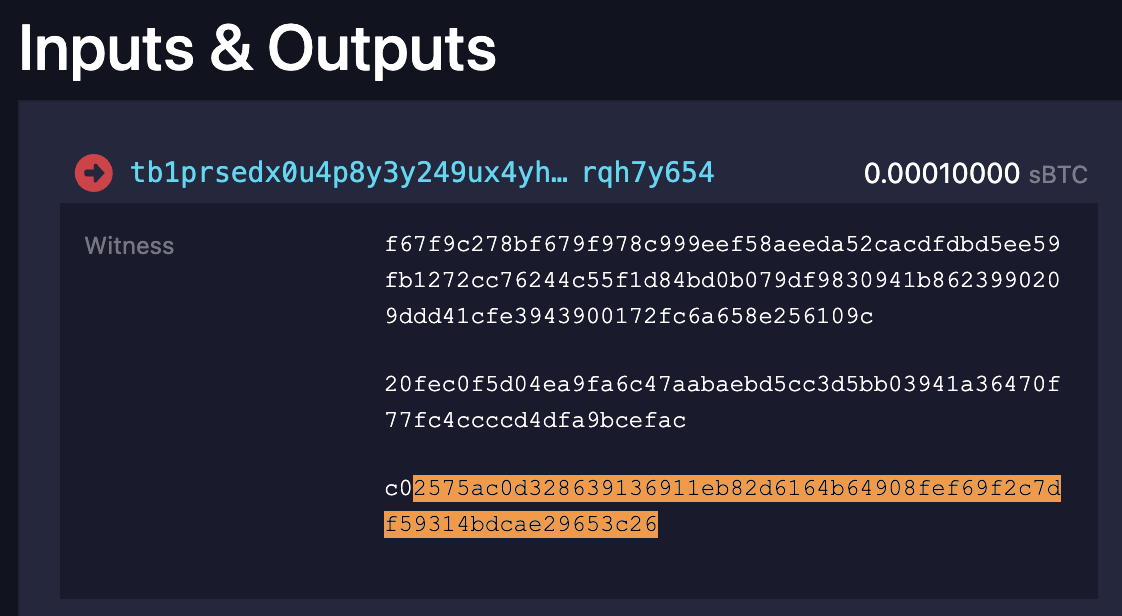
 bitryonix ·