Betting on Bitcoin Upgrades: A Smart Contract Wager on OP_CAT Activation
No oracles. No middlemen. Pure on-chain logic that works today.
OP_CAT, proposed in BIP 0347, aims to enhance Bitcoin’s scripting capabilities by allowing concatenation of two stack elements, enabling complex covenants and smart contracts. In the ever-evolving world of Bitcoin, soft forks like OP_CAT spark heated debates about functionality, security, and adoption. But talk is cheap — what if you could put your money where your mouth is? Enter Alice and Bob, two Bitcoin enthusiasts betting on whether OP_CAT will activate by a specific time or block height. Using a clever Bitcoin smart contract, they create a trustless, oracle-free wager that ensures one walks away with the prize, with real skin in the game. We can implement a trustless bet on OP_CAT’s activation today, using only existing Bitcoin opcodes. It’s Bitcoin-native, self-enforcing, and doesn’t rely on third-party arbitration like Polymarket. No soft fork is needed.
Alice believes OP_CAT, which redefines OP_SUCCESS126 to enable string concatenation (BIP-347), will activate by block height 900,000 (roughly November 2025, assuming 2-week difficulty adjustments). Bob, skeptical of miner consensus, bets it won’t. They agree to lock 1 BTC each into a smart contract with clear rules:
If OP_CAT is active by block height 900,000, Alice wins and claims 2 BTC.
If OP_CAT is not active by block height 900,000, Bob wins and claims 2 BTC.
No oracles or third parties are allowed — the contract must resolve using Bitcoin’s blockchain alone.
This isn’t just a friendly wager; it’s a financial commitment that forces both to back their convictions with real capital, embodying the “skin in the game” ethos.
Why It’s Tricky: The OP_SUCCESS126 Challenge
Designing this contract is no small feat. OP_CAT’s activation hinges on redefining OP_SUCCESS126, a placeholder opcode that, pre-activation, causes any script executing it to succeed immediately. This means a naive script expecting OP_CAT to fail pre-activation (e.g., to block Alice’s spending) would instead allow Alice to claim funds prematurely, breaking the bet’s logic. To overcome this, Alice and Bob need a contract that distinguishes OP_CAT’s post-activation behavior (concatenation) from OP_SUCCESS126’s pre-activation behavior (immediate success) without external data.
The Smart Contract Design
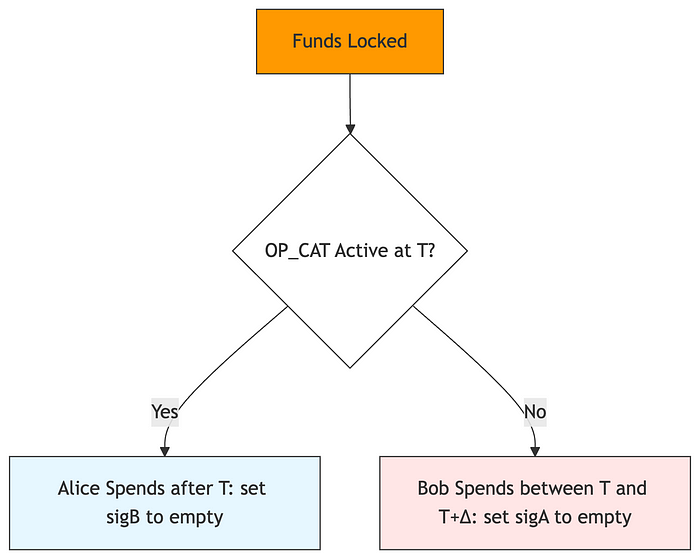
The contract uses a Taproot output with a single script path/tapleaf with two conditional branches¹. The script is compiled from the following sCrypt smart contract.
sha256(a + b) == toByteString('00..00') is impossible: no inputs from concatenating two strings hash to all zeros. +is the concatenation operator and compiles to OP_CAT. This assertion at Line 18 will always fail if OP_CAT is re-enabled. It can only succeed if OP_CAT is not re-enabled, when Bob wins.
Absolute timelockabsTimelock() (compiled to OP_CHECKLOCKTIMEVERIFY/CLTV, instead of relative timelock OP_CSV) ensures neither can spend before the agreed activation deadline.
We add more time delay delta for Alice at Line 20, because otherwise she can also spend even if OP_CAT is not re-enabled at the block height and may frontrun Bob. The time delay can be set conservatively long to ensure Bob’s spending transaction can be mined before Alice’s attempt, say, 48 hours. Note that once OP_CAT is reactivated, it will remained reactivated after delta.
In the context of this bet, MEV could arise if miners influence OP_CAT’s activation to manipulate the outcome. For instance, miners could accelerate signaling to favor Alice. However, as long as the total bet amount remains relatively small, the financial incentive for miners to engage in such manipulation for a softfork is limited, and we do not consider MEV a significant concern here and deem it out of scope for this analysis.
Final Thoughts
This isn’t theoretical — you can deploy this right now. It leverages Bitcoin’s existing rules to create a self-executing, trustless bet on OP_CAT’s future activation. It also sets a precedent for other prediction markets (e.g., betting on other opcodes, protocol changes).
Want to try it? Find a counterparty, agree on activation block height and lock the funds. The blockchain enforces the rest.
No soft forks. No oracles. Just Bitcoin.
[1] Alternatively, we can uses a Taproot address with two script paths: one for Alice’s win, the other for Bob’s. We choose one script path for ease of exposition here.
doesn’t seem to work because of how OP_SUCCESSx works – it makes immediately trivially satisfiable any script containing an op_sucess, with no logic executed around it.
Note OP_SUCCESSx (such as OP_SUCCESS126, i.e., OP_CAT after activation) only makes a script immediately succeeds if EXECUTED.
For example, the script will not automatically succeed just because OP_SUCCESS3 is in the code — it only triggers success if actually run. If this script is evaluated with OP_FALSE on the stack, the OP_IF branch with OP_SUCCESS3 is not executed, so the ELSE branch runs instead.
Similarly, in our case, branching condition at Line 16 ensures only Bob can get OP_SUCCESS126 executed (i.e., when OP_CAT is still disabled), thus succeed. Alice cannot trigger OP_SUCCESS126, which is what we want.
This is incorrect. The mere presence of an OP_SUCCESSx opcode in a BIP 342 tapscript makes it automatically evaluate to true. Quoting BIP 342, emphasis mine:
The script as defined in BIP341 (i.e., the penultimate witness stack element after removing the optional annex) is called the tapscript and is decoded into opcodes, one by one:
…
If any opcode numbered 80, 98, 126-129, 131-134, 137-138, 141-142, 149-153, 187-254is encountered, validation succeeds (none of the rules below apply). This is true even if later bytes in the tapscript would fail to decode otherwise. These opcodes are renamed to OP_SUCCESS80, …, OP_SUCCESS254, and collectively known as OP_SUCCESSx.
…
The tapscript is executed according to the rules in the following section, with the initial stack as input.
I think the scheme works, but only if you split the branches into separate script leaves.
The inclusion of OP_SUCCESSx in a script will pass it unconditionally. It precedes any script execution rules to avoid the difficulties in specifying various edge cases, for example: OP_SUCCESSx in a script with an input stack larger than 1000 elements, OP_SUCCESSx after too many signature opcodes, or even scripts with conditionals lacking OP_ENDIF.
Correct, OP_SUCCESSx will make a script succeed, even if NOT executed. “split the branches into separate script leaves” would not help, since timelock check at Line 17 will be bypassed, even if it precedes OP_SUCCESS126. Bob can take the bet fund before the deadline. Additional measures, like Taplock, must be taken to hide the script, so Bob is unable to spend it before the deadline.
In practice, standardness rule has SCRIPT_VERIFY_DISCOURAGE_OP_SUCCESS, which would make any script containing OP_SUCCESSxfail immediately, instead of succeeding.
So the above scheme works, assuming no miner colludes with Bob by turning off SCRIPT_VERIFY_DISCOURAGE_OP_SUCCESS. Updated the original article.
 sCrypt ·
 Final Thoughts
 Jeremy Rubin ·
  Garlo Nicon ·
  sCrypt ·
  Pieter Wuille ·
  Chris Stewart ·