Nostr uses the same cryptography to generate keys as bitcoin. So, users can generate new keys from npub and receive bitcoin payments.
Motivation
BIP 47 v1 uses OP_RETURN for notifications
Silent payments scanning affects UX
Protocol
Alice would generate a new key for Bob and share the notification as encrypted message using NIP-17. Bob’s wallet will save the details to receive payments from Alice in future. Alice will get a new address for Bob by incrementing counter.
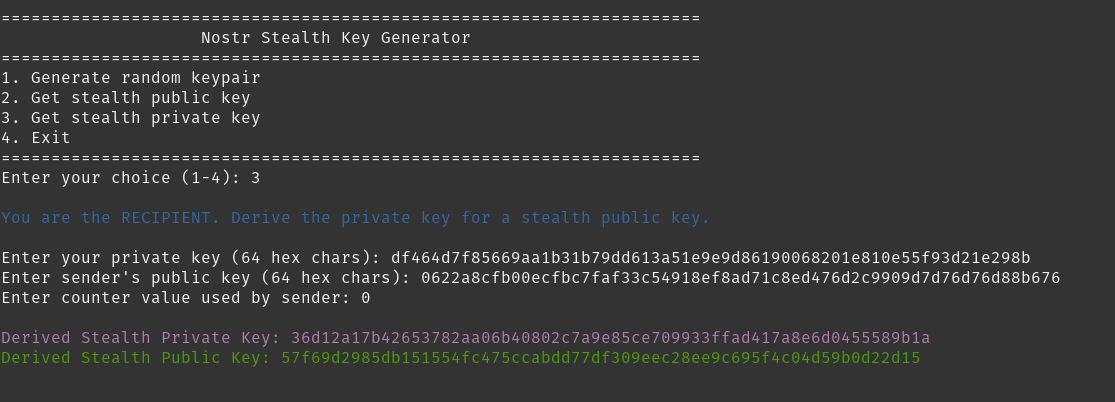
A BIP or NIP could be written to describe the specifications and below is a proof of concept:
So, users can generate new keys from npub and receive bitcoin payments.
Just for ease of review, could you outline with equations what exactly the proposal consists of? What is in the notification? What’s the exact structure of the public key that Alice pays to? (like P = B\_{nostr} + H(aB\_{nostr}|i)G?) (I’m setting aside scan/spend distinction there because I think that was your intention, but I’m not sure). And is the idea to avoid scanning that Bob stores a batch of addresses for Alice that he can watch for? (Sorry if that last question misses the point, but I don’t understand in detail what you’re proposing here) (my interest here is more analyzing the structure from a crypto point of view, than arguing about what the right design choices are, which explains why I’m mostly interested in just seeing the proposal written out in detail, than discussing whether it’s good or not!).
One thing I was trying to clarify was this part of the description. In the above, is B a key that is being used as an npub? And A, also? (I guess the latter, not, because she wouldn’t need to send it perhaps?)
Yes A and B are keys used as npub on nostr. Its not necessary to send it and would entirely depend on the protocol if someone uses this for stealth addresses.
Interesting idea, I have a few quick thoughts to share. As somebody who works a lot on Silent Payments I find this particularly interesting.
How would you make sure that no transactions are “lost”? As nostr has no global state, several scenarios come to mind where somehow a notification is “lost” or missed.
It’s inherent to nostr that if Alice and Bob don’t share a relay Bob will not see notes broadcasted by Alice. So some prior agreement on which relays to use would be needed?
If a relay deletes a note and before Bob has seen the note he will never know of the payment either. I guess one could solve this with a confirmation message. Alice could rebroadcast the notification note until Bob confirms receiving the notification. But this would only work if relay sets have an overlap.
The above issue could be somewhat mitigated if a wallet always makes sure it has checked for all i ± x the last received i. But this only helps if Bob receives several transactions from Alice. There seems to be no fallback for the receiver to find transactions (e.g. brute force searching for new payments).
Another worry I’d have are malicious actors flooding the receiver with fake notifications. Silent Payments in it’s “base case” checks Transactions accepted by a node, which has protection (e.g. PoW for confirmed txs) against transaction flooding.
What if Alice accidentally looses count of i/reuses an already used i? It’s the same two parties making the transaction which is not a big problem but probably not optimal either. A deterministic nonce could help but not sure what that could be in the nostr context.
Compared to Silent Payments your proposal has basically no scanning effort which is quite nice. But a clear downside I currently see is the statelessness of nostr. If the receiver does not get the notification he will not know that he ever received a payment.
I’m not deep in the weeds on nostr’s recent developments on private messaging without leaking metadata. It seems though that pairing your idea with silent payments could be quite interesting. i.e. I could see nostr notifications as an easy way to notify receivers of new Silent Payments. They could always fallback to a full chain scan if necessary (e.g. Bob suspects a missed transaction). My worries for nostr notifications were/are always the metadata leakage but I think some efforts were made to reduce that issue. Would be interested in hearing your opinions on the risk of metadata leakage when notifying receivers.
Notifications don’t need to be saved forever by the relays. Once received by the wallet, it can be saved offline.
If multiple relays are used by the sender and recipient, they are unlikely to get lost. One of them could be run by the wallet developer.
Some common relays would exist if they are using the same wallet. Other wallets may agree on using the same list of relays.
There is no incentive for a relay to delete the event although broadcasting the event to multiple relays would avoid this. Confirmation message could also be used in the protocol.
Fake notifications can be managed by normal spam filtering used in other nostr clients and relays.
Pairing the idea with silent payments sounds interesting and I had discussed it with @moonsettler.
Metadata leaks are fixed and only exist in NIP 4.
Note: Electrum wallet already uses nostr relays in the wallet. So it will be easier to implement this as a plugin.
I tried to make a little write up to structure what was discussed above. It might help others to better understand the idea presented here. I took the liberty to make some small changes or annotations where I believe some improvements could be made. I marked those with (*). Maybe some of the things were implied, marking them nonetheless.
Counter: i, counter starting from 0. +1 for every pubkey Alice generates when sending to Bob
Crypto
Shared Secret (S): a * B or b * A (remember that parity matters here and the nostr protocol implies even parity for it’s keys)
Stealth component (c): Hash_tagged(S || i)
Stealth Address Pubkey: P = B + c * G
Stealth Secret Seckey: p = (b + c) mod n (where n is the curve order)
Alice encodes P to a taproot script and sends to it. Address = "5120 + P" where P is a 32 byte x-only pubkey.
Communication
Communication starts after Alice has already made the transaction
Alice: notifies Bob of the transaction. The message needs to at least include the counter. But more information can/should be given to make finding the actual outpoint easier
(*) Bob: upon receiving the notification should validate the utxo and store the pubkey
(*) Bob: if (2) was successful send a simple confirmation message - could include the counter to avoid confusion with potential other transactions which Alice made to Bob
(*) Alice: until receiving the confirmation message with a counter i should periodically rebroadcast the notification message
Backup (*)
Note: As a general statement: Bob has no option to find out whether all transactions made to him have been seen by him
Recovering from scratch:
nsec-only: Bob is dependant on relays still having all the relevant notification messages available to find his transactions
nsec + backup file: A simple list mapping sender npubs and the respective highest counters
Additional Notes
General opinionated ideas for improving the Stealth Address protocol
Signaling of receive support:
Alice must not send to Bob if Bob does not signal support for the protocol anywhere. Ignoring this will most definitely lead to lost funds some time or another unless combined with the below point of reclaiming utxos considered unredeemed
Reclaim branch:
I’m imagining a simple block delay after which Alice can reclaim coins she believes to be unredeemed. Something like 3 months would give Bob plenty of time to claim and move the coins. Alice could get back the coins if she thinks they were “lost”. She can obviously always decide to not move the coins f she thinks Bob has heard of the coins and still has the ability to spend them
e.g. Alice can use a script path spend to send the coins back to an address she controls if it should turn out that Bob does not support Stealth Addresses or never received the notification and Alice has no other way of notifying Bob
Use Silent Payments logic instead of new stealth address specific logic
The above protocol can easily be redefined to using Silent Payments for the underlying crypto part
The notification message could contain the tweak of the transaction made to Bob. So Alice would send a Txid and optionally the tweak (input_hash * A) and/or the computed pubkeys for the transaction she made. Bob’s scanning effort would be minimal to zero (only validation of information Alice sent)
Bob can always fallback to scanning the entire chain if he believes that a notification message was lost. Silent Payments only use on-chain available data to derive the pubkeys for Bob. As long as Bob somehow has access to blockchain he can find everything which was sent to him
Added benefit: wallets would be more interoperable
Swapping in the silent payment logic for pubkey derivation and combining it with nostr notifications would basically remove a lot of the potential footguns with Stealth Addresses as I currently see them. It would still achieve the goal of a reduced scanning effort and the added benefit of not yet another way for deriving keys
One thing I almost forgot. Technically the spend and scan secret keys for Silent Payments don’t have to be created using the key derivation paths. A nostr specific way could be thought of to make this also more compatible in a nostr case
I think I have addressed most of your points in the write up. One thing I’m currently not super convinced on is a wallet mainly based on nostr. More specifically a wallet that stores critical data within nostr without any sort of reliable fallback. I have heard of Cashu wallets doing something like that but have also heard of relays intentionally nuking their dbs.
There is also no incentive to not delete. Maybe I would even argue that storage requirements incentivize the deletion of notes (especially old ones).
Is there any information on that. I have never heard of NIP-17 seeing big adoption. If the NIP is mainly used for Stealth Addresses this would be a form of metadata leak.
I guess one could further argue that if Alice finds the npub of Bob and feels like sending to Bob there must have been some common hop between them to begin with.
It doesn’t have to be a wallet based on nostr. You just need some relays in the settings and a library that could be used for several things. Electrum uses it for submarine swaps.
I will work on an electrum plugin that can be used to test this concept with a bitcoin wallet. I would call them color addresses that use colors as HRP instead of npub.
@1440000bytes I have come up with a starting point for a spec which i eluded to in my comments. It melts your idea of notifications via Nostr with the standard Silent Payments protocol. Commenting in case this is still interesting for you.
Thanks for the update and the use of nostr for notifications in silent payments. I have created an electrum plugin to test the idea shared in this thread: /dev/fd0 / color-address · GitLab
 /dev/fd0 ·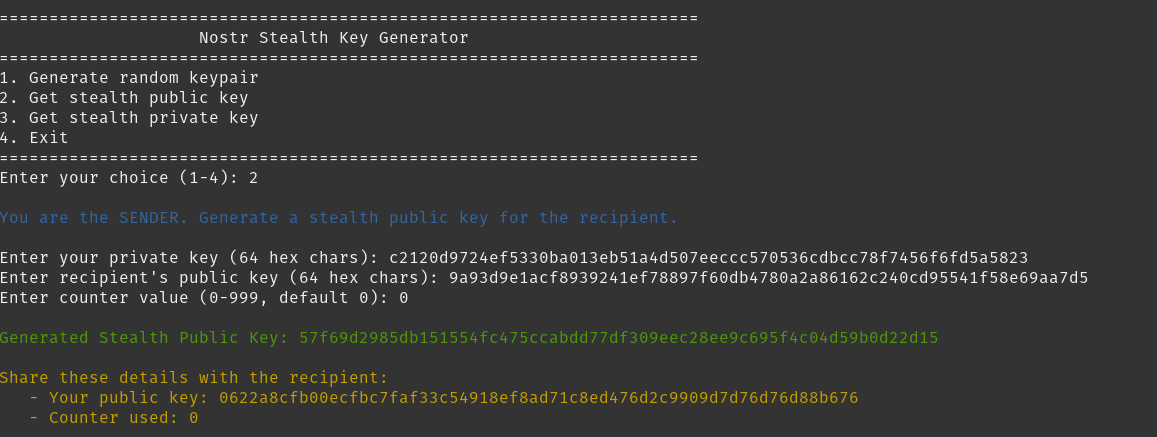
 Adam Gibson ·
  setavenger ·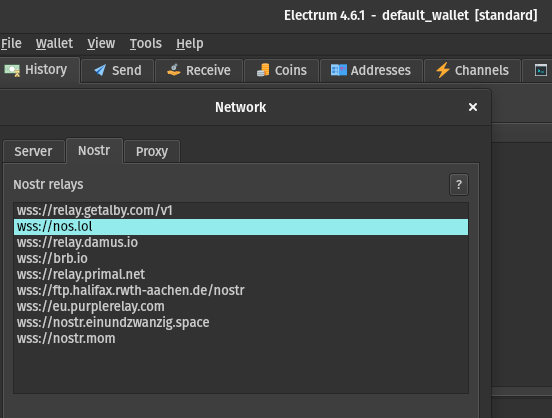
 ArmchairCryptologist ·
  securitybrahh ·