Recent discussions around P2MR (BIP-360) and legacy address sunsetting (draft BIP-361) highlight two practical bottlenecks for Bitcoin’s post-quantum transition:
- Institutional Custody Statefulness: Custodians running distributed signing servers across isolated availability zones and restoring keys from cold backups cannot safely deploy stateful hash-based PQC schemes where counter desynchronization leads to key compromise.
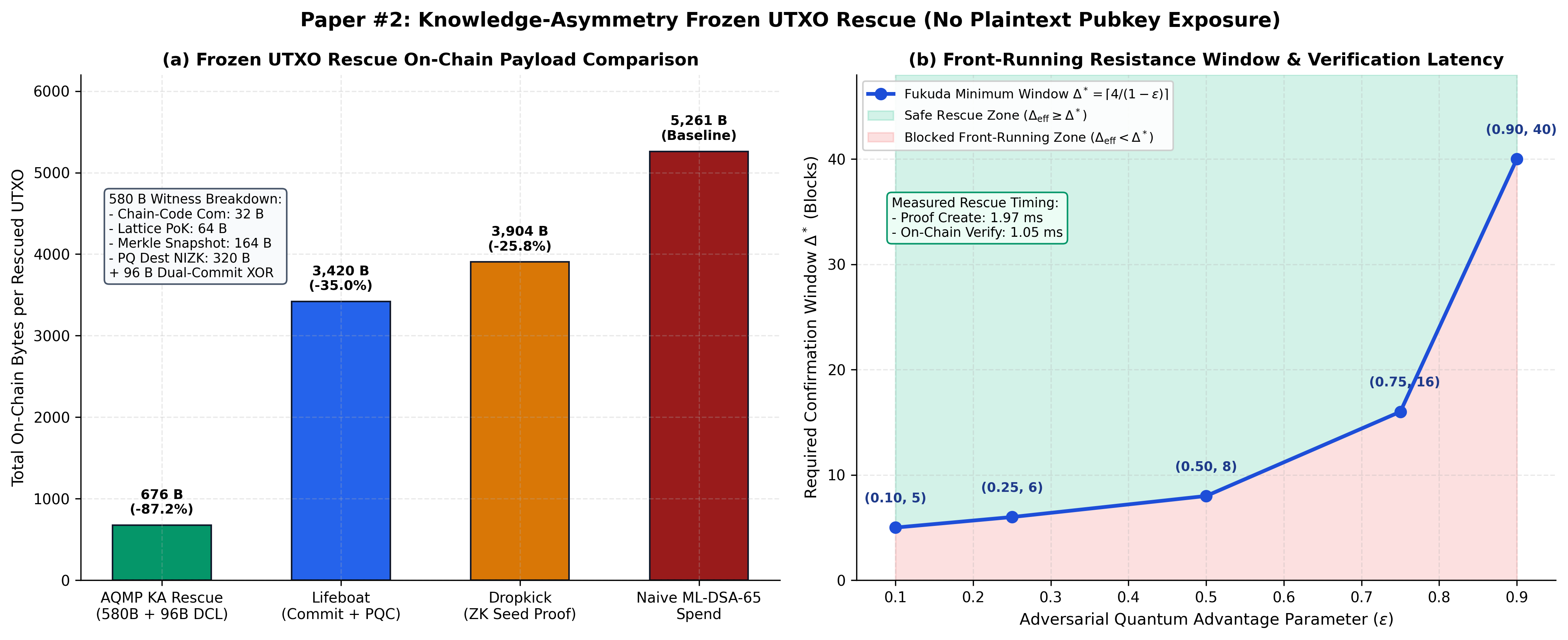
- Legacy UTXO Rescue Overhead: Roughly 34% of Bitcoin supply sits in legacy outputs exposed to quantum public-key recovery or scheduled freezing. Existing rescue proposals require large on-chain witnesses (3,420 B for Lifeboat and 3,904 B for Dropkick).
I have published a technical paper and reference implementation addressing both constraints as part of the Adaptive Quantum Migration Protocol (AQMP v2.0).
1. Knowledge-Asymmetry Frozen UTXO Rescue (676 B Total)
Instead of exposing raw elliptic-curve public keys on-chain during emergency migration, the protocol derives a post-quantum lattice key s_{KA} \in \mathbb{F}_q^{32} from the unhardened BIP-32 parent chain code (c_{\text{par}}) and pre-compromise derivation path (P_{\text{par}}, i).
- Witness Breakdown: 32 B chain-code commitment + 64 B lattice PoK transcript + 164 B Merkle inclusion proof + 320 B destination lattice-NIZK = 580 B.
- Front-Running Protection: Bound to a 96 B Dual-Commit XOR cycle (C = F(x) \oplus F(x \parallel m)) gated by the consensus confirmation deadline \Delta^* = \lceil 4/(1 - \epsilon) \rceil.
- Comparison: At 676 B total, this reduces on-chain witness size by 80.23% relative to Lifeboat (3,420 B), 82.68% relative to Dropkick (3,904 B), and 87.15% relative to naive ML-DSA-65 (5,261 B).
2. Stateless PQ-MPC Threshold Engine
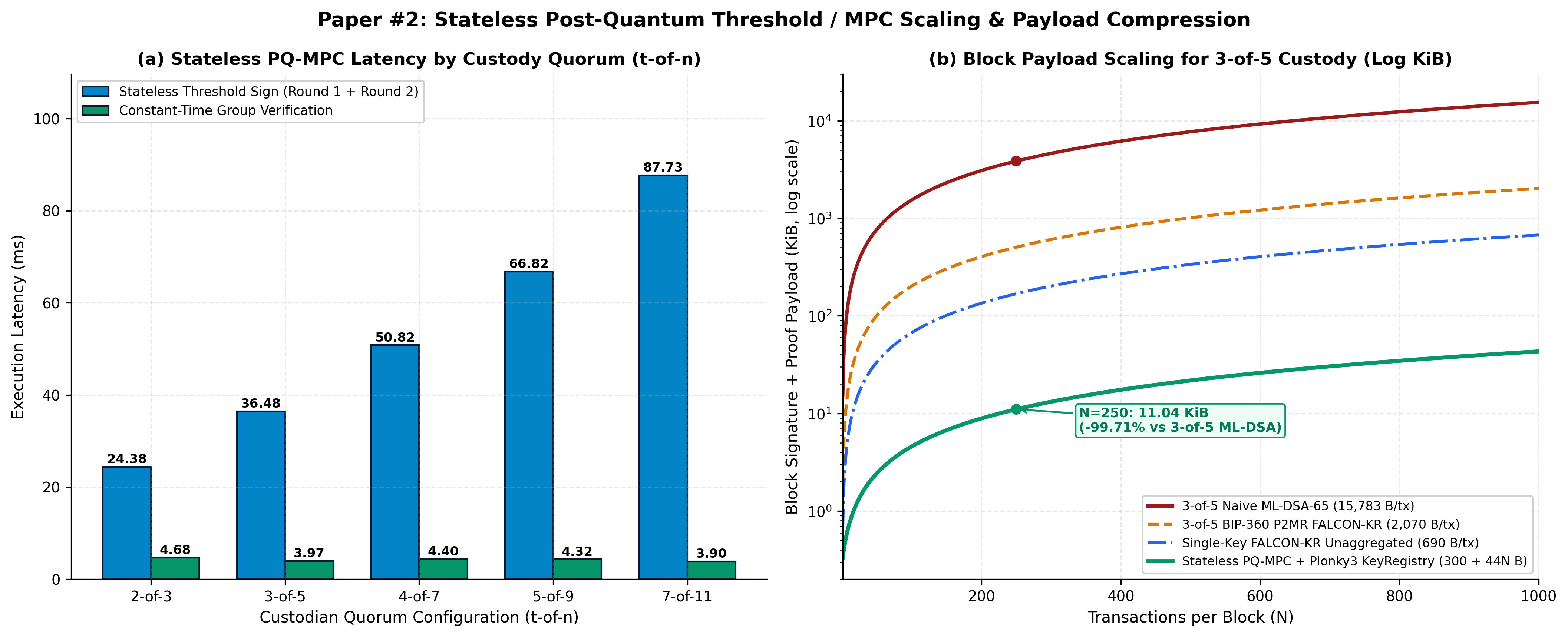
For institutional custodians, the module implements Shamir secret sharing and Lagrange interpolation over \mathbb{F}_q^{64} (q = 8,380,417) with synthetic HMAC-SHA3-256 nonces bound to the message digest, share commitment, active quorum set, and a backup-safe epoch salt.
- Zero Mutable State: Wiping local node state and restoring from cold backup produces identical, deterministic partial signatures with zero nonce reuse.
- Measured Performance: Verification stays constant between 3.90 ms and 4.68 ms across 2-of-3, 3-of-5, and 7-of-11 quorums. When paired with P2MR roots and 4-byte KeyRegistry Plonky3 aggregation, a 3-of-5 block at N = 250 transactions drops from 3,945,750 B (naive ML-DSA-65) to 11,300 B (-99.71%).
Links & Reproducibility
- Paper #2 (PDF & CSV Dataset): Stateless Post-Quantum Threshold Signatures and Knowledge-Asymmetry Frozen UTXO Rescue for Blockchain Custody and Legacy Supply Migration | Zenodo
- BIP Draft & Reference Implementation (62 passing pytest tests): GitHub - laudzakusuma/aqmp-protocol: A toolkit and reference implementation for Post-Quantum Blockchain Migration addressing the PQC Migration Trilemma. · GitHub
I welcome technical critique on the BIP-32 chain-code knowledge-asymmetry assumptions and the Dual-Commit XOR mempool window bounds.