
Introduction
Deanonymizing a transaction and learning its source is possible, though only probabilistically`. E.g LinkingLion style. An observer may get a noisy guess: Bitcoin Core announces to outbound peers on a ~2s timer and to inbound peers on a shared ~5s timer, this poisson timers to some certain extent blur the signal I think.
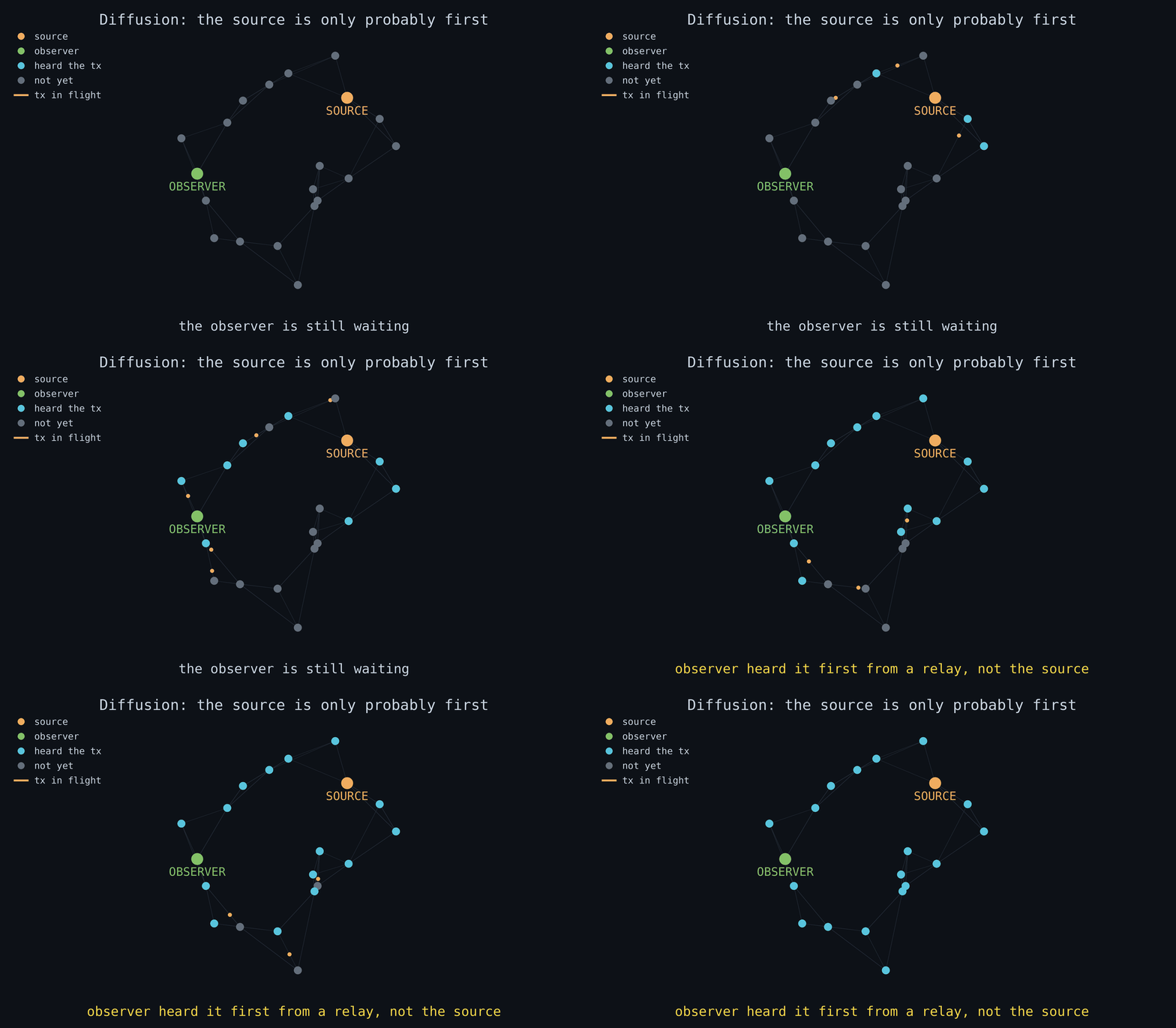
Moreover the LinkingLion variant is passive. The current Bitcoin Core wallet rebroadcast gives a stronger attack. The rebroadcast is a deterministic signal, and in a simulation, I was able to link the address to the node whose wallet tracks it 100% of the time. This post discusses the issues with wallet rebroadcast, presents my simulation results, revisits topology discovery after knowing the source, and discusses suggested mitigations.
What the attacker needs
The attacker knows a candidate on-chain address, can build and broadcast a tx paying it, can run one or more listening Bitcoin nodes, can connect to candidate nodes (or attract their outbound connections), can observe P2P tx announcements, and is willing to wait out the 12-36h rebroadcast.
Linking an address or UTXO to the node tracking it
This is a long-known leak, not a new one (bitcoin#3828, bitcoin#36403). A wallet re-announces an unconfirmed transaction it holds, whether sent or received, to peers after it stays in the wallet unconfirmed for 12-36h.
By passively listening an adversary may link IPs to addresses. Passively waiting for a victim’s own payment to stay unconfirmed that long is rarely useful, since most transactions carry enough fee to confirm well before the 12-36h window.
The active version plants a small payment into a confirmed address, sending a new transaction to an already-used address from a confirmed UTXO, paying an output of at least the dust threshold. It is unlikely to confirm quickly, so the tracking node’s wallet resends it on its own 12-36h timer. Connect a fresh peer to each candidate node, and the node that re-announces a planted transaction is running a wallet that tracks that address.
A watch-only wallet is also affected, it tracks an address without holding its key
(IsMine is script-membership only, with no key check), so the attack pins the node whose wallet recognizes the address, which may not be the party that controls the funds. A relay does not re-announce an old mempool transaction to a newly connected peer [1].
In the tested configurations this was 100% successful. The periodic resend initiates a broadcast to transaction-relay peers even while the planted tx is still in the node’s mempool. Normal per-peer announcement suppression still applies, so a peer already told isn’t told again, but a freshly connected spy hasn’t been told and receives the announcement.
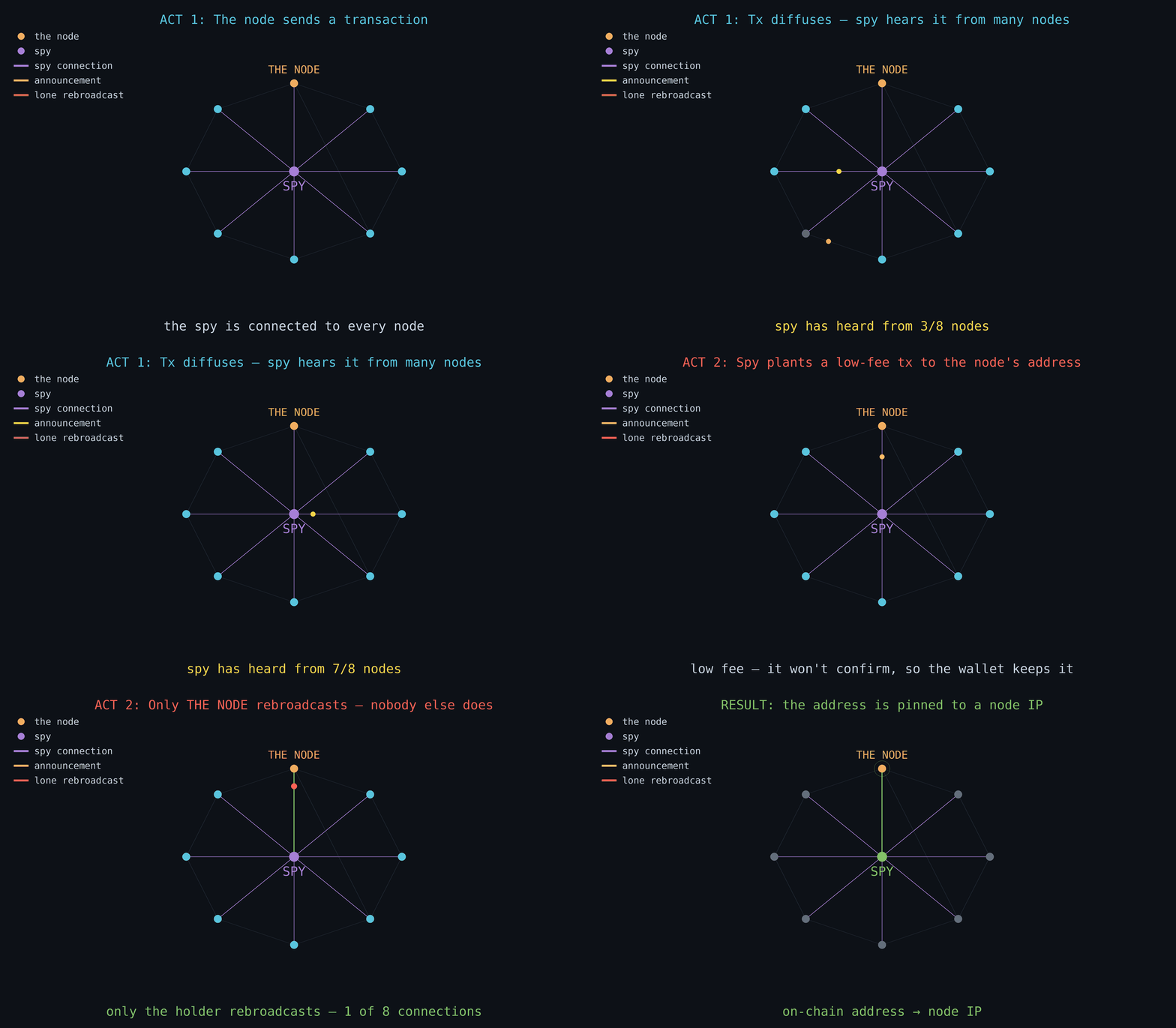
Simulating this on regtest
On regtest, a hub plants one such payment into each of K target wallets and a fresh spy connects to each; over K=5 targets across 6 trials (30 attributions) the spy linked the address to the correct node 100% (30/30) of the time.
The lab brings up stock Dockerized Bitcoin Core nodes on regtest. A hub node funds and plants the
low-fee payments; each target is a separate node whose wallet holds its planted payment unconfirmed. The
targets ran default Core descriptor wallets with keys (hot wallets via createwallet); a watch-only wallet
(disable_private_keys=true) would behave identically here.
A fresh P2P spy connects to each candidate and records every transaction it is told about, and the candidate that announces a planted txid is the node whose wallet tracks it.
Cost of the attack
The planted payment needs to relay but not confirm. The default minimum relay fee is 0.1 sat/vB. The planted output must clear the dust threshold, so rough estimate modelling each planted transaction as one input and two output of the listed type.
| Output type | vB | Fee | Dust | One planted tx | Cost (USD) |
|---|---|---|---|---|---|
| P2WPKH | 141 | 15 sat | 294 sat | 309 sat | $0.18 |
| P2TR | 154 | 16 sat | 330 sat | 346 sat | $0.20 |
| P2PKH | 226 | 23 sat | 546 sat | 569 sat | $0.34 |
At approximately $59,000/BTC (25 November 2026), one planted transaction costs approximately $0.18–$0.33, including its dust output and relay fee.
Fingerprinting candidate UTXOs
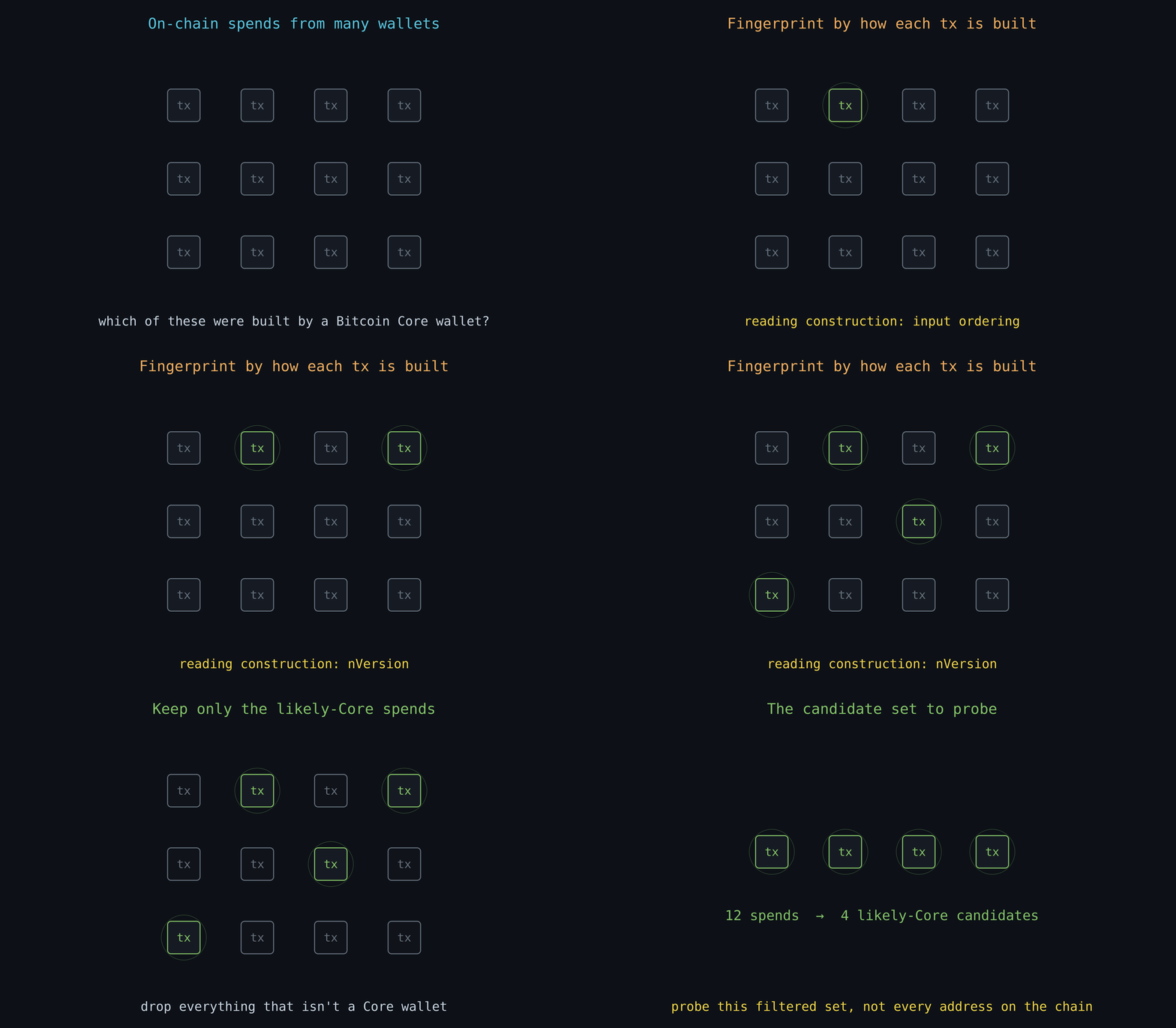
Wallet fingerprinting reads the wallet software off a transaction’s construction: input ordering, change-output position, nVersion, locktime and anti-fee-sniping, and so on. You don’t have to scan every address. Cluster the on-chain spends, use the change heuristics to guess which wallet made each one, keep the spends that look like a Core wallet, and plant only against those.
Clustering reachable UTXOs across the network
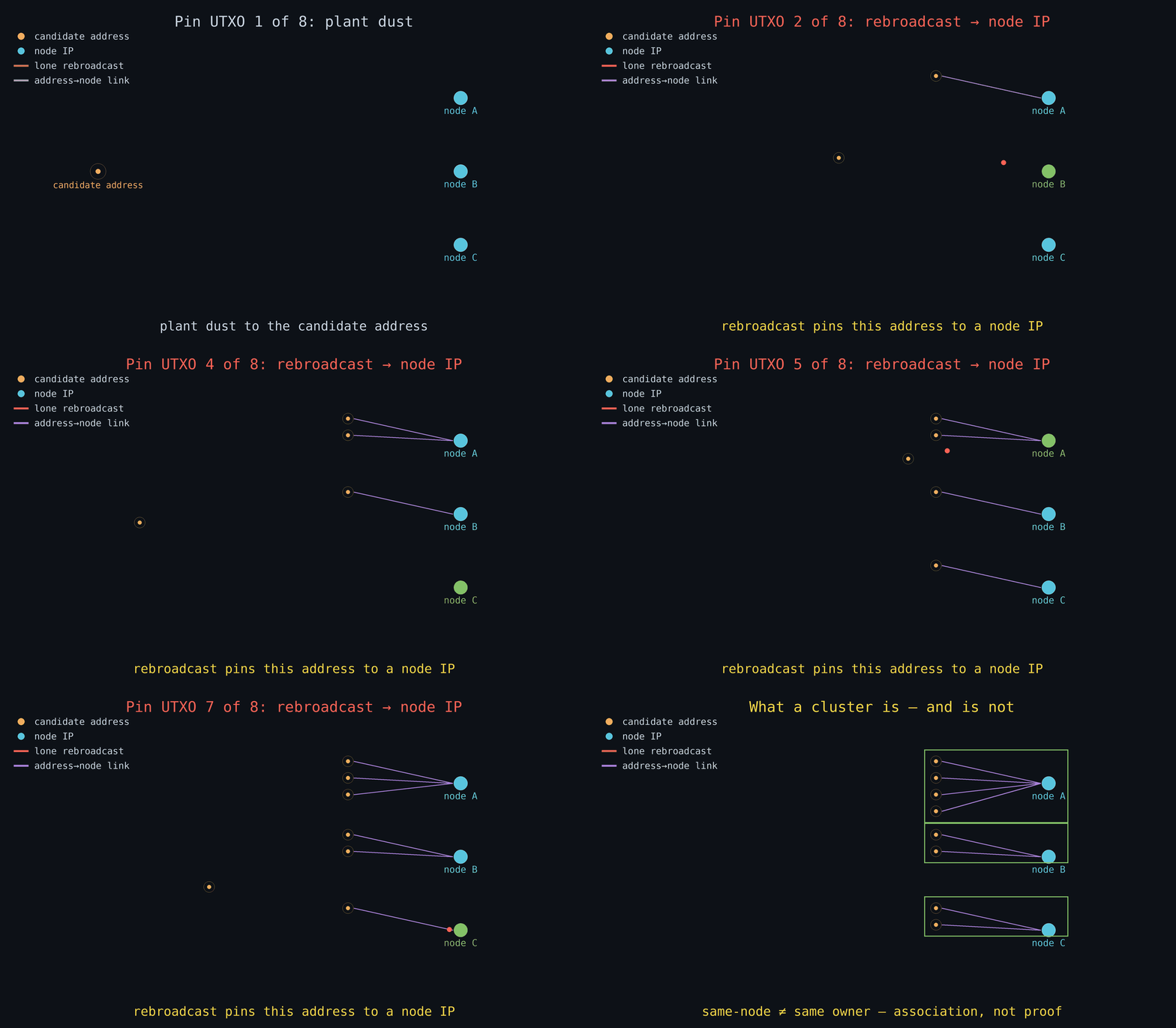
One use case of this deanonymization is clustering. Each hit gives an address-to-node association, and repeating it across candidate UTXOs builds a map of which addresses were seen at which nodes. Node identity is not proof of common ownership, though: one entity can run many nodes, and a node’s wallet can track addresses it doesn’t own (a watch-only server, an exchange, or a shared service) Still this is a useful data point for chain analysis.
So even if you never reuse an address, the map still reveals an address-to-node association.
Capturing non-listening nodes
Many non-listening nodes are behind NAT or otherwise unable to accept inbound connections, so you cannot connect to them. To observe them, run listening nodes and advertise your address so non-listening nodes dial out to you; they become your inbound peers and the same attribution applies. An entity with a wide, diverse presence (many netgroups and ASes, LinkingLion-style) can probabilistically get more non-listening nodes to dial out, increasing the number you can observe.
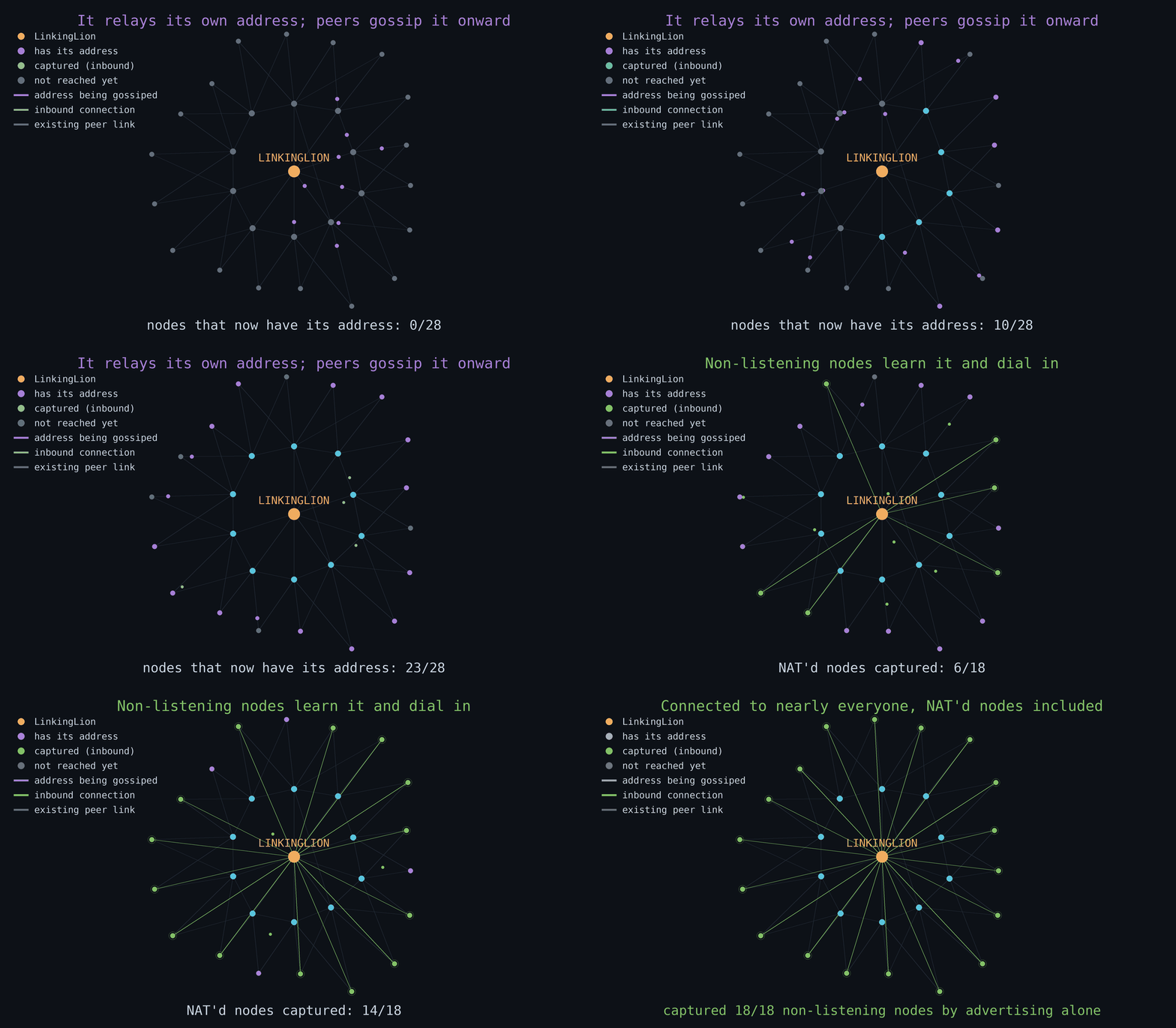
Transactions broadcast privately can be captured
Private broadcast does not protect against this, in two ways.
If the user sends a low-fee tx with -privatebroadcast and it sits unconfirmed for 12-36h, the periodic
resend falls back to InitiateTxBroadcastToAll and leaks it to all peers. The private path only covers the
first announcement; the rebroadcast ignores it.
If instead the privately-broadcast tx confirms immediately, or was pushed through a third-party node or Tor pusher while the address is watched in a Core wallet, the attacker plants a new low-fee payment to an address from that tx and waits for the Core wallet to rebroadcast the planted tx.
A node that runs on several networks at once rebroadcasts to all of them. The rebroadcast relays via InitiateTxBroadcastToAll, which announces to every peer with no network filter. A node that reaches the
network over Tor or I2P for privacy but also keeps clearnet peers will re-announce the planted transaction over clearnet too, leaking its clearnet IP. Only a node configured -onlynet=onion (or otherwise without clearnet peers) avoids this.
Affected software
The leak is in the Bitcoin Core wallet, and it fires on watch-only and hot wallets too. So any software that loads its addresses into a Core wallet inherits the leak, whether that is a watch-only wallet (createwallet with disable_private_keys=true plus
importdescriptors/importmulti) or a hot spending wallet.
Potential affected wallets are:
| Software | How it uses Core |
|---|---|
| Bitcoin Core / Knots | native descriptor wallet, -walletbroadcast default true |
| Sparrow | Bitcoin Core (“Cormorant”) mode only |
| Specter Desktop | Core RPC, watch-only descriptor wallet |
| Liana | bitcoind backend mode |
| Fully Noded | Core RPC, disable_private_keys wallet |
| Gordian Wallet | Core RPC, importmulti watch-only |
| JoinMarket / Jam | Core watch-only wallet (user runs createwallet per docs) |
| Lily Wallet (v1.0.7) | Core RPC, importmulti watch-only |
| Electrum Personal Server | importmulti watch-only into Core |
| Caravan (local bitcoind) | importdescriptors watch-only |
| bwt (Bitcoin Wallet Tracker) | createwallet + importmulti watch-only |
| Eclair | no internal on-chain wallet; uses a Core hot wallet |
Extending to topology discovery
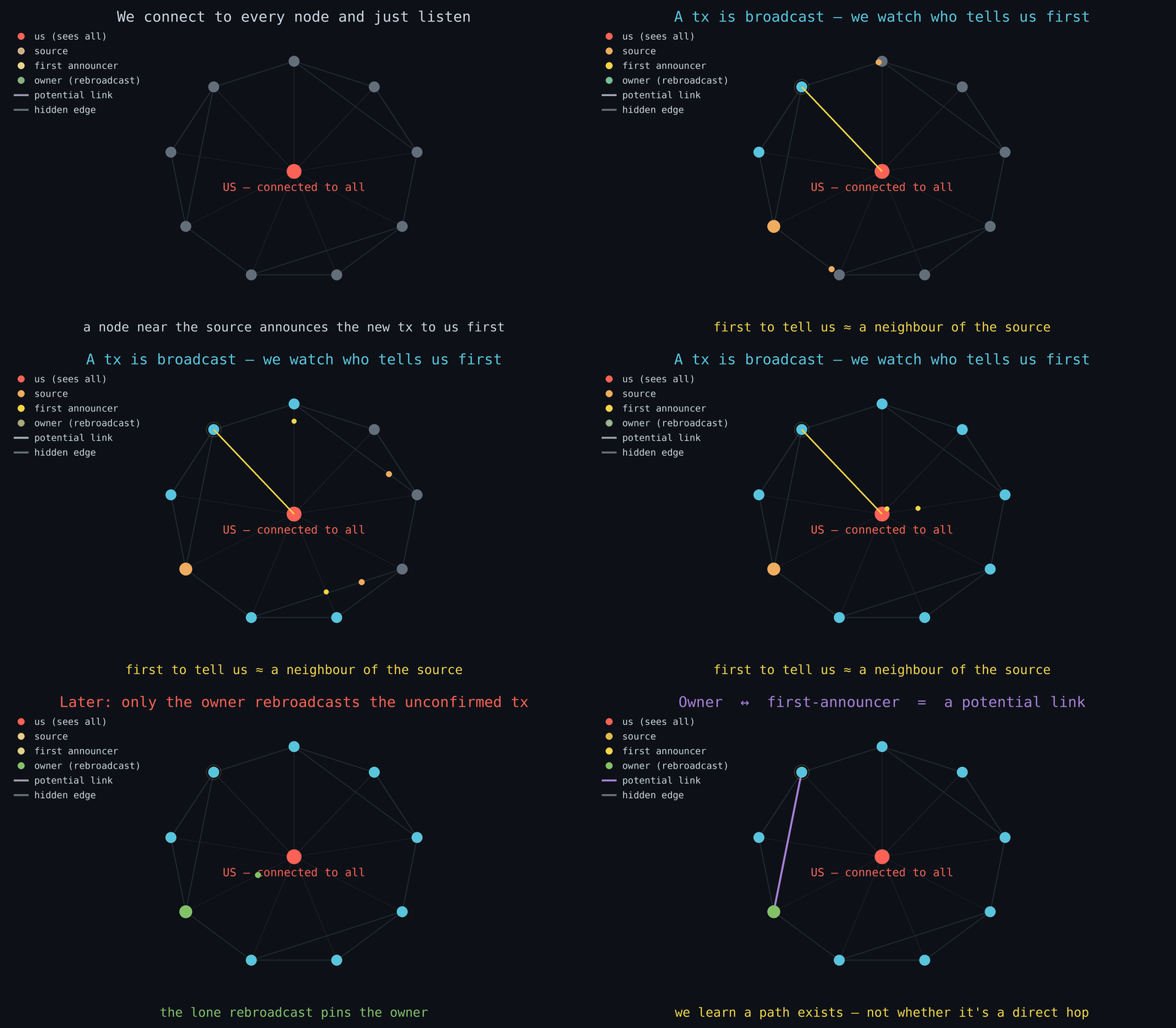
The rebroadcast already deanonymizes the source. The remaining question is whether watching the tx spread also reveals the source’s neighbours. Somewhat: it reveals the single likeliest neighbour, and little beyond that.
The planted tx can’t be reused here. Once you broadcast it the network already has it, so when the victim rebroadcasts 12-36h later, peers that still hold it in mempool drop the inv and don’t relay it further. So this timing measurement applies to a freshly originated transaction from the now-known source, or a rebroadcast of a tx that peers had previously evicted, rather than the already-in-mempool planted tx.
I simulated a fresh broadcast from the now-known source and watched it spread, with an observer that is inbound to every node so it hears each node the first time that node announces. I measured this on a fork of sr-gi’s Hyperion GitHub - sr-gi/hyperion: A discrete time network event simulator for Bitcoin · GitHub, source taken as already known.
The graph built is synthetic. Every node makes 8 outbound connections to uniformly-random reachable nodes hyperion’s default, reachable nodes also take inbound, and non-listening nodes take none, so it is a directed random 8-out graph with relay connections treated as undirected when computing hop distance.
| Graph (reachable / total) | 2nd announcer is within one hop | a ≥3-hop node beats a 1-hop node |
|---|---|---|
| 2,000 / 20,000 | 185/200 = 92.5% | 200/200 sims (100%) |
| 10,000 / 100,000 | 181/200 = 90.5% | 200/200 sims (100%) |
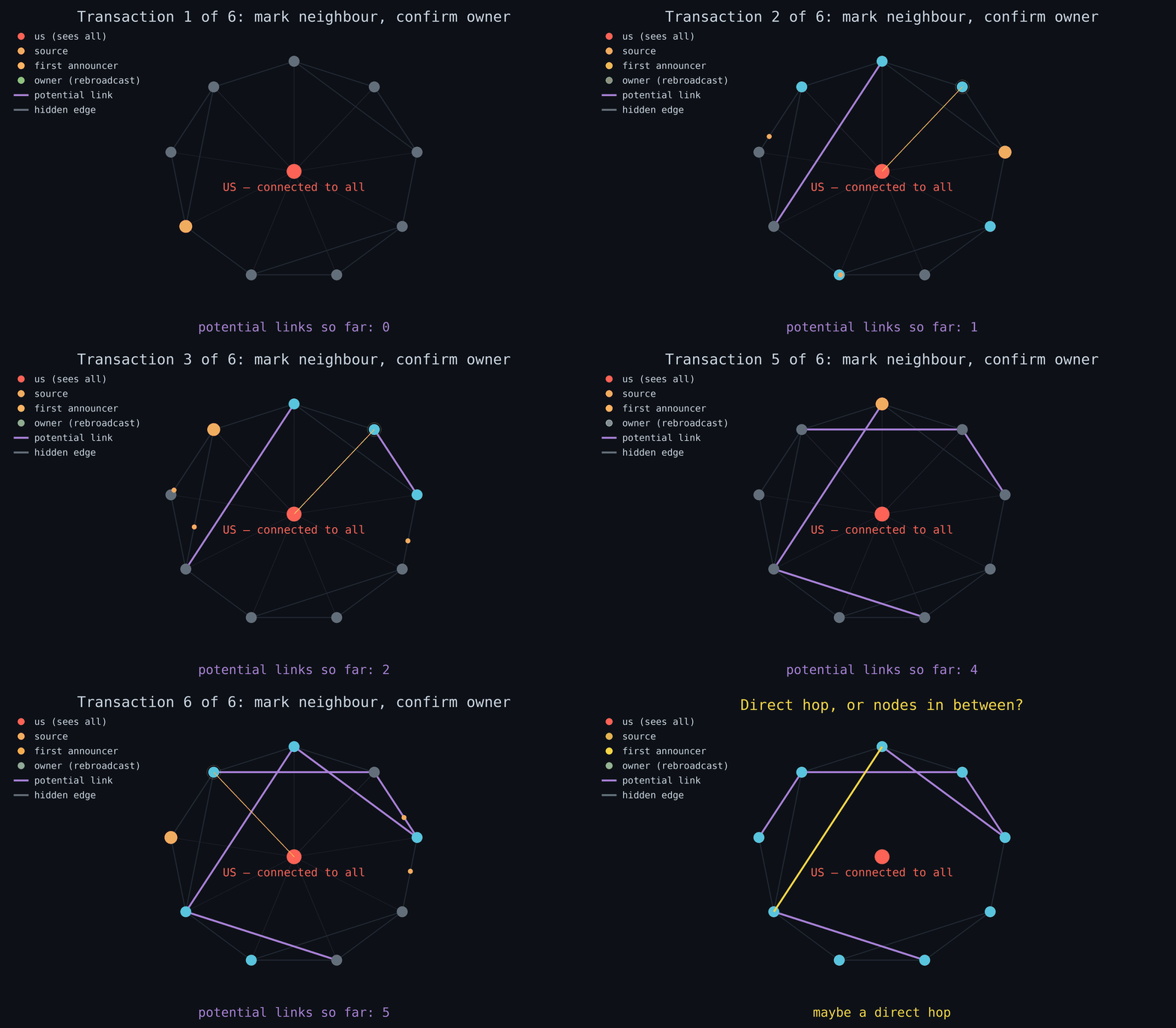
The first node we hear after the source (the 2nd announcer) is a direct neighbour ~90% of the time at both graph sizes (2,000 and 10,000 reachable). Out of all the source’s direct peers, the fastest one usually announces to our observer before the transaction has had time to travel further.
That signal does not let you map out the rest of the source’s peers, though. Because each node waits on a random ~5s timer before announcing to inbound peers, a slow 1-hop peer can easily wait 10+ seconds while the transaction jumps several hops and a faster 3-hop node announces first. In all 200 simulations, at least one ≥3-hop node announced before at least one real 1-hop peer so timing can flag one likely neighbour at the very top, not rank or list all of the source’s peers.
The ~90% is an empirical result for this model under favourable assumptions. It is not a measured mainnet rate, and two sizes at 200 seeded runs with an ideal observer do not establish a bound on real Bitcoin topology.
Mitigations
-
One way not to leak is to turn off wallet broadcasting.
-walletbroadcast=0does more than stop the rebroadcast: it disables all wallet-initiated relay. The wallet no longer announces your own new transactions either, so you keep-walletbroadcast=0and broadcast your own sends throughsendrawtransaction, which relays once via the node’sBroadcastTransactionpath. -
Another fix would be a dedicated option for the periodic (re)broadcast, which would still have to decide what to do about received transactions whose only announcement would be that path.
-
bitcoin/bitcoin#36482 proposes only rebroadcasting a transaction that was newly added to the mempool, which removes the leak[2].
| Mitigation | privacy benefit | trade-off |
|---|---|---|
-walletbroadcast=0 |
kills the rebroadcast signal | disables all wallet broadcasting, including the initial send of your own txs; you must relay them yourself |
| bitcoin#36482 (only rebroadcast a tx newly added to the mempool) | removes the signal for a planted tx that just sits in the mempool | a proposed PR, not released; does not eliminate every rebroadcast leak[2:1] |
| avoid Core watch-only/hot-wallet integration? | sidesteps this wallet behaviour entirely | needs a different backend architecture |
-onlynet=onion / -onlynet=i2p |
stops clearnet IP exposure even if rebroadcast stays on | still links the address to the node’s onion/I2P identity |
This was brainstormed jointly with @polespinasa during bitcoin research week, thanks to b10c @stratospher @sr-gi, Mathias and a few others for answering my questions.
Mistakes and oversight here are entirely my own. The code is available publicly GitHub - ismaelsadeeq/core-wallet-rebroadcast-research · GitHub.
A relay does not re-announce an old mempool transaction to a newly connected peer. The caveat: a small-mempool relay does not rebroadcast on its own, but if it evicts the planted tx and later receives the victim’s rebroadcast, it treats the tx as new and re-relays it to its peers (including a spy), a false positive or secondary announcer. ↩︎
The eviction path that still leaks under #36482: if the planted tx is evicted from the victim’s own mempool (for example under mempool pressure) and the wallet later resubmits it, that counts as newly added, so even the “only rebroadcast if newly added” rule rebroadcasts it again. ↩︎ ↩︎

